





Description
| Product Name | CAT.No | Size |
| Monoclonal Grouping Kit | BGABD030 | 3 x 10ml |
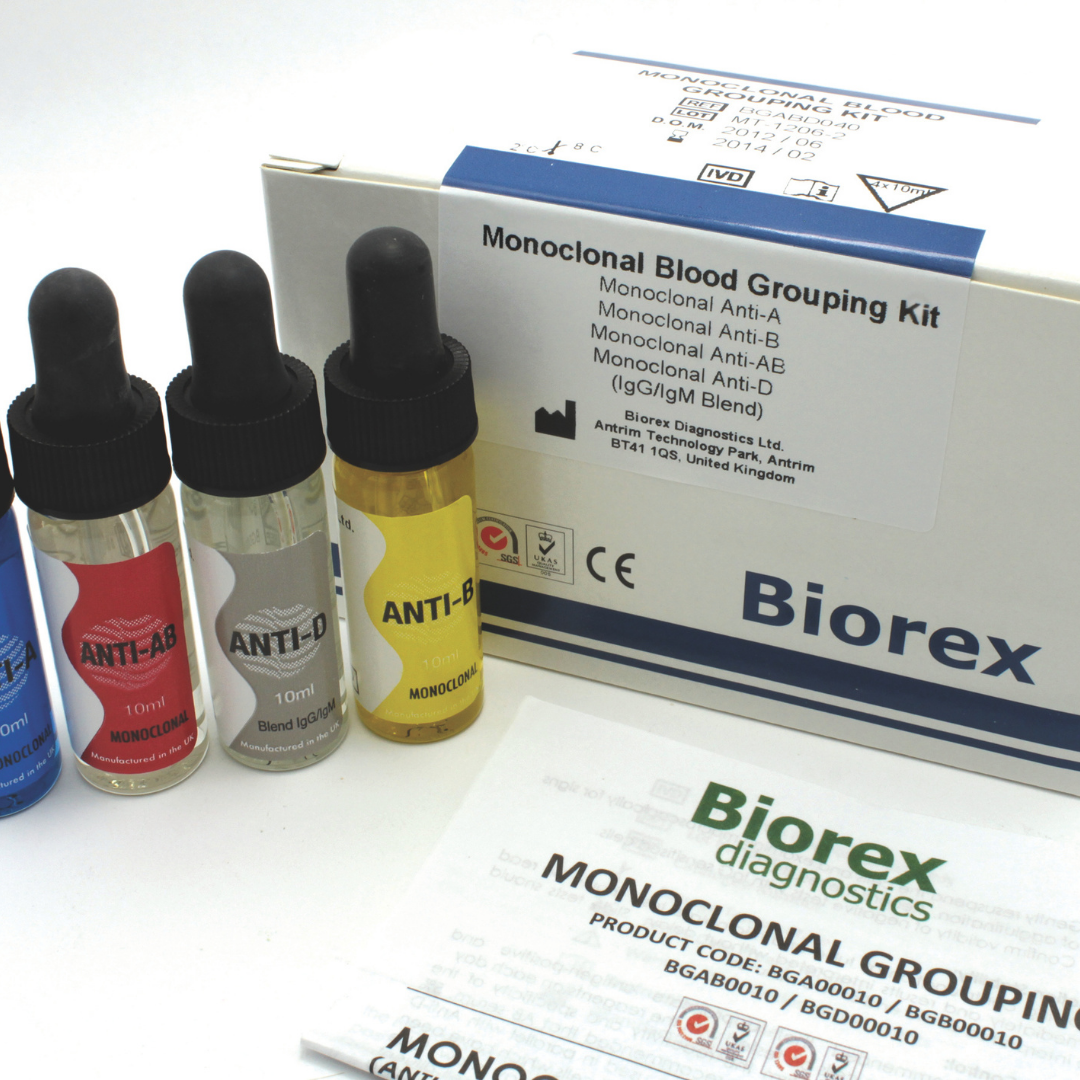
| Monoclonal Grouping Kit | BGABD040 | 4 x 10ml |
Product Description
The Biorex Diagnostics Monoclonal Grouping Kit is a ready-to-use solution designed for the accurate and reliable detection of ABO and RhD antigens in human red blood cells. Utilising high-quality monoclonal antibodies, the kit provides precise and reproducible results, supporting safe blood transfusions, routine blood typing, and emergency immunohaematology testing. Its direct agglutination method delivers clear, interpretable outcomes, allowing laboratories to perform rapid and confident blood group determination.
The kit’s ready-to-use reagents eliminate the need for dilution or preparation, reducing handling errors and streamlining workflow. The monoclonal antibodies offer high specificity, ensuring consistent detection of A-, B-, AB-, and O blood groups as well as D-positive and D-negative phenotypes. This level of accuracy minimizes the risk of false results and enhances confidence in transfusion compatibility, critical for patient safety in both routine and emergency clinical settings.
Key Features
- Accurate ABO and RhD antigen detection – identifies all major blood groups and D antigen status
- Monoclonal reagents – highly specific for consistent and reliable results
- Direct agglutination method – clear, easily interpreted results for fast decision-making
- Ready-to-use kit – reduces laboratory errors and saves time with minimal preparation
- Supports transfusion safety – ensures donor–recipient compatibility and prevents alloimmunisation
Benefits
The Monoclonal Grouping Kit enables laboratories to perform reliable ABO and RhD typing, enhancing transfusion safety and reducing the risk of incompatible blood administration. Its user-friendly, ready-to-use format simplifies laboratory procedures, while the high specificity and reproducibility of the monoclonal antibodies improve result accuracy. The kit is suitable for blood banks, hospital laboratories, and reference immunohaematology facilities, supporting both routine and emergency testing. By facilitating rapid and dependable blood group determination, it contributes to safer transfusions, efficient clinical workflows, and improved patient care. Overall, the Biorex Monoclonal Grouping Kit provides a cost-effective, high-performance solution for immunohaematology testing, ensuring laboratories can maintain high standards of quality, safety, and reliability.
Contact Us for more information.